
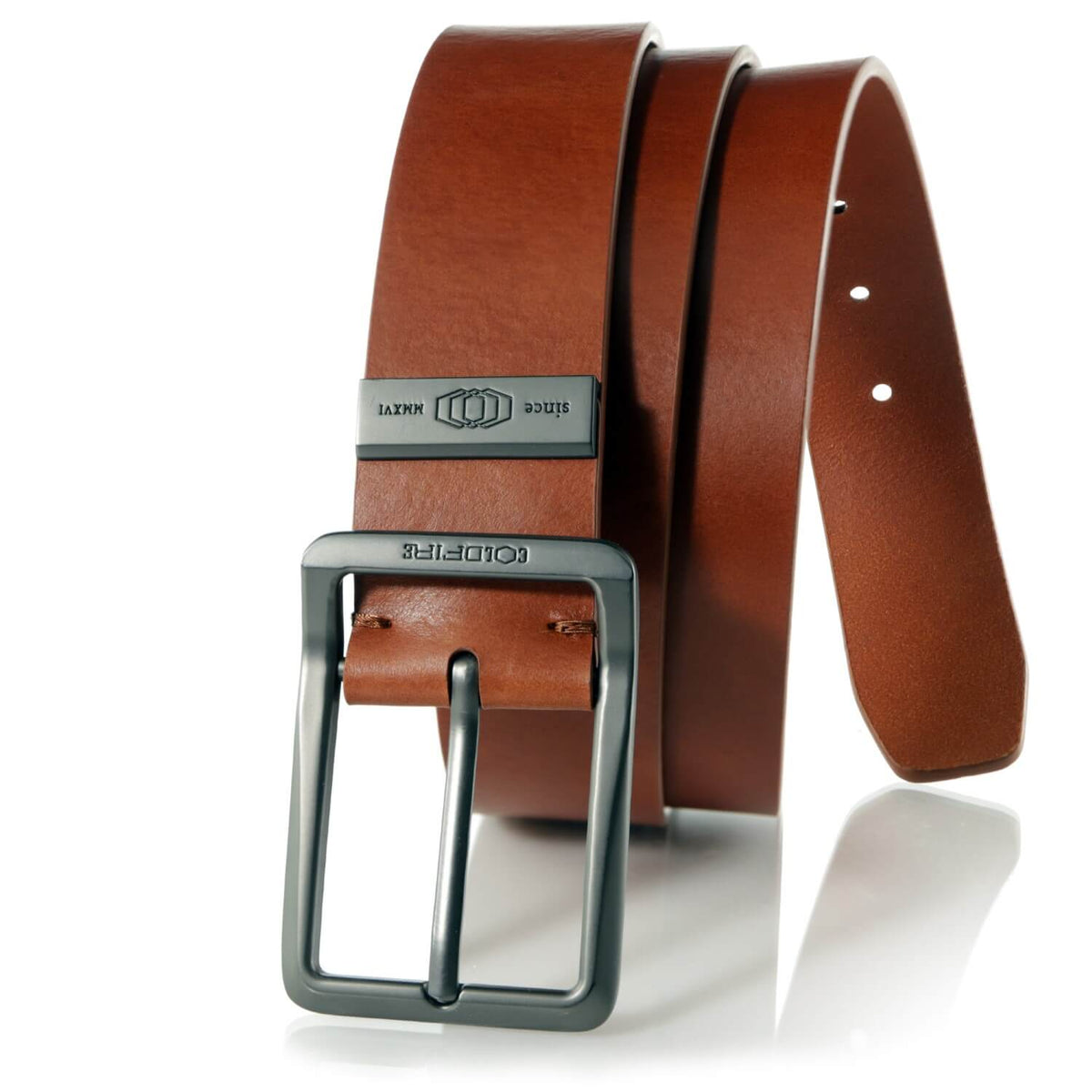
A good leather belt should outlast several pairs of trousers, and most of what shortens its life is avoidable: the wrong hole punched with a nail, a conditioner that was meant for boots, a buckle that was never meant to come off. We have made belts in Plovdiv since 2000 and repaired a good many that came back to us, so this is the maker's version of belt care: how to punch a clean hole, how to clean and condition full-grain leather without ruining the finish, how to soften a stiff belt, how to shorten one properly, and when to stop and buy a new one.

First, know what your belt is made of
Every instruction below assumes a full-grain or top-grain leather belt: a single strip cut from a hide, with the natural grain surface on the outside. If your belt is bonded leather (leather fibres glued together and coated, usually marked "genuine leather" or nothing at all) or a coated split, most of this does not apply. Bonded belts cannot be conditioned back to life, because there is no fibre structure to feed; they crack at the holes and peel at the edges, and the honest advice is to replace them. You can tell the difference at the cut end: full-grain shows one solid layer with visible fibre, bonded shows a sandwich with a thin skin on top.
How to punch a hole in a leather belt
This is the most common repair and the most commonly botched. A hole made with a nail, a screwdriver or a drill bit tears the fibres instead of cutting them; the hole stretches into an oval within weeks and becomes the point where the belt eventually splits. A proper hole is cut, not pierced.
- Buy or borrow a rotary leather punch. They cost little and have six tube sizes. Choose the tube that matches the existing holes; on most men's belts that is 4 to 5 mm.
- Mark the position. Measure the spacing between the existing holes and keep it. Lay a ruler along the centre line of the strap, mark with a pencil or the tip of an awl, and check that the mark sits exactly on the centre; a hole even 2 mm off centre is visible and loads one side of the strap.
- Punch from the grain side. Place the tube on the mark, squeeze firmly in one motion. If the strap is thick (ours is 3.8 mm) rotate the punch a quarter turn under pressure to cut cleanly through the flesh side.
- Finish the hole. Push a drop of leather edge paint or neutral balm into the raw edge with a toothpick so it does not drink water and darken. Skip this on light tan leather if you do not have a colour-matched product; a dark ring is worse than a bare hole.
Two limits. Do not punch closer than 25 mm to the end of the strap, or the tip will tear. And do not add more than two holes beyond the original set towards the buckle: if you need a third, the belt is the wrong size and should be shortened at the buckle end, which is described below. Our belt size chart explains how to order the right size in the first place, which avoids all of this.
How to clean a leather belt
Dust and dry dirt come off with a soft brush or a dry cloth. For sweat marks, denim dye transfer and general grime, dampen a cloth with lukewarm water, wring it almost dry, wipe the strap along its length and let it air-dry away from heat. For anything stubborn use a small amount of saddle soap or a pH-neutral leather cleaner on the cloth, never directly on the belt, and wipe the residue off with a second damp cloth. Let it dry fully, overnight if needed, before conditioning.
What not to use: dish soap, alcohol wipes, baby wipes, vinegar, and anything containing solvents. They strip the fats out of the leather and leave it dry and prone to cracking. Never put a belt near a radiator or in the sun to dry faster; heat is what cracks leather, not water.
How to condition a leather belt
Conditioning puts back the oils and waxes that leather loses to sweat, washing and time. A full-grain belt worn daily wants it about twice a year; a belt worn occasionally, once a year or when it starts to feel dry and look dull. More often is not better, and here is the mistake we see most: a belt that has been oiled every month arrives at the workshop limp, dark and stretched, because oil-soaked fibres lose the tension that makes a belt hold its shape.
Use a neutral leather cream or balm, not neatsfoot oil or mink oil. Those are for work boots and will soften a belt until it sags. Apply a thin film with a cloth, work it along the grain, leave it twenty minutes, then buff off whatever has not absorbed. Test any product first on the inside of the strap near the buckle: some balms darken leather permanently, and that is fine on black, a problem on cognac.

How to soften a stiff leather belt
A new full-grain belt is supposed to be stiff. The stiffness is the structure that keeps it flat against your waist for years, and it eases on its own within two or three weeks of wear as the fibres at the fold points loosen. Wear it, bend it gently by hand along its length a few times a day, and be patient.
If you want to speed it up, one light coat of conditioner as described above is the most you should do. Do not soak it in oil, do not put it in water, do not run it over a table edge, and do not heat it. Every one of those softens the belt quickly and permanently, and a belt that is soft all the way through is a belt that will stretch and curl. The goal is a strap that flexes at the hip and stays flat everywhere else.
How to shorten a leather belt
The correct place to shorten a belt is at the buckle end, not the tip. Cutting the tip ruins the shape of the point and moves the holes out of proportion. Shortening at the buckle keeps everything in place. Whether you can do it at home depends on how the buckle is attached.
Snap buttons or screws: open them, pull the buckle and loop off, measure how much to remove (the difference between your current hole and the centre hole is the usual amount), cut the strap square with a sharp blade against a steel ruler, cut a new slot for the buckle tongue with a punch and a knife, mark and punch new snap holes, and reassemble. Take your time with the slot; it should be just long enough for the tongue to swing freely.
Stitched buckle: this is a workshop job. The stitching has to be unpicked, the strap cut, the fold re-skived and re-stitched on a machine that handles 3.8 mm leather. Any cobbler or saddler will do it for a small fee, and it is a better outcome than a home attempt with needle and thread.
Cracks, curling and stretched holes: what can be fixed
| Problem | Cause | Fix |
|---|---|---|
| Surface dryness, fine lines | Lost oils | Clean and condition. Full recovery. |
| Deep crack across the strap | Heat, long neglect, or bonded leather | Not repairable. A crack through the fibre is structural. |
| Oval, stretched hole | Same hole used for years, or a pierced hole | Move to the next hole or have the belt shortened so a fresh hole takes the load. |
| Strap curls lengthwise | Over-oiling or thin leather | Stop conditioning, store flat or hanging. Partial recovery. |
| Edges fraying or peeling | Bonded or painted split leather | Not repairable. Replace. |
| Loose or broken buckle | Hardware failure | Replace the buckle if it is removable; otherwise a saddler can re-stitch a new one. |
| Dye on light trousers | Excess surface dye on a new belt | Buff hard with a dry cloth several times; it stops after the first weeks. |
How to store belts
Hang them by the buckle or roll them loosely, grain side out, and keep them out of sunlight and away from heating. Do not leave a belt threaded through the trousers in a heap on a chair; the fold it dries into becomes a permanent kink. If you own several belts, rotate them. A full-grain belt that rests a day between wears dries out fully, keeps its shape longer, and will look better at year five than one worn every single day.
What we build into a Titan Grip belt, and why it matters here
Our Titan Grip belts are cut from one piece of full-grain Italian leather, 3.8 mm thick and 38 mm wide, with gunmetal hardware and a five-year guarantee. That construction changes the care routine in two ways. At 3.8 mm the strap takes a punched hole without distorting, and it tolerates years of the same hole before it shows an oval. And because it is full-grain throughout, it conditions properly: the cream goes into real fibre and comes back out as suppleness, not as the sticky surface you get on a coated belt. The buckle on a Titan Grip is stitched, not snapped, with the branded plate behind it fixed by screws, so shortening is a saddler's job as described above; the screws hold the plate and are not a release for the buckle. The whole care programme for a Titan Grip is a damp cloth when it needs it and a neutral balm twice a year. Everything else on this page is for belts that were made with less.
- Care, daily
- Nothing. Hang it up.
- Care, as needed
- Damp cloth, air-dry
- Conditioning
- Neutral cream, twice a year, thin coat
- Never
- Oil soaks, heat, solvents, nails as hole punches
- Extra hole
- Rotary punch, same spacing, on the centre line
- Shortening
- At the buckle end; Titan Grip buckles are stitched, so by a saddler
Choosing a belt that will not need most of these repairs is covered in Men's Leather Belts: How to Buy One That Lasts. The belts themselves are in the Titan Grip series, or browse all men's belts.
Questions, answered
How do you punch a hole in a leather belt without a punch?
You should not. A nail, drill or screwdriver tears the fibres and the hole stretches into an oval within weeks, often becoming the place the belt splits. A rotary leather punch costs little, cuts the hole cleanly and is the only method a maker would use. If you have none to hand, a cobbler will punch one in a minute.
How often should you condition a leather belt?
About twice a year for a belt worn daily, once a year for one worn occasionally, using a thin coat of neutral leather cream. More often does harm: over-conditioned leather goes limp, darkens and stretches, which is the opposite of what a belt needs.
How do you soften a stiff new leather belt?
Mostly by wearing it. Full-grain leather eases at the fold points within two or three weeks. Flex it gently by hand along its length a few times a day, and apply one light coat of conditioner if you want to speed it up. Do not oil-soak, wet, heat or drag it over an edge; those soften it permanently and it will stretch and curl.
Can a cracked leather belt be repaired?
Fine surface lines from dryness recover with cleaning and conditioning. A crack that goes through the strap cannot be repaired, because the fibre structure is broken; the belt will fail there. Cracks at the holes and peeling edges on bonded leather belts are also beyond repair.
How do you shorten a leather belt?
At the buckle end, never the tip. If the buckle is held by snaps or screws, remove it, cut the strap square, cut a new tongue slot and snap holes, and reassemble. If the buckle is stitched, have a cobbler or saddler do it; it needs a machine that stitches thick leather.
Can you clean a leather belt with soap and water?
With a barely damp cloth and, for stubborn marks, a little saddle soap or pH-neutral leather cleaner, yes. Not with dish soap, alcohol wipes or anything containing solvents, which strip the leather's oils. Let it air-dry away from heat and condition it afterwards if it feels dry.
Written by Todor Georgiev, founder of COLDFIRE and a leather goods manufacturer in Plovdiv since 2000. Published 2 November 2026. Based on workshop practice and repairs seen on belts returned to COLDFIRE; product figures are COLDFIRE specifications.

Share:
Do You Need an RFID Wallet? What Contactless Skimming Can and Cannot Do