
By Todor Georgiev, founder of COLDFIRE. Published October 9, 2026. One of the eight wallets below is ours. It is not ranked first, and each entry says plainly where another wallet does the job better.
"Durable" is the most abused word in wallet marketing, so this comparison uses a narrow definition: a bifold is durable if, after two years of daily carry, the card slots still grip, the closed thickness is still what you bought, nothing structural has stretched, cracked or detached, and the maker is still on the hook for it. That rules out a lot of good-looking wallets and rewards a few boring ones.
I have made leather goods in Plovdiv, Bulgaria since 2000 and carbon fiber wallets since 2016, which means I have seen the failure modes first-hand: stretched cowhide slots, elastic straps that go slack, glued clips that let go, and rubber edge seals that peel. The eight below were picked because each one survives at least one of those failure modes by design.
What actually fails on a bifold
- Card slots stretch. Cowhide is a fiber mat with no memory. Ten insertions a day for a year widens a slot by 1–2 mm and the wallet swells. Dense-fiber leather (shell cordovan, kangaroo) resists this; composites and metal do not stretch at all.
- Mechanisms wear. Elastic straps, spring ejectors and money clips are consumables. A wallet with no moving parts has nothing to replace.
- Edges and coatings peel. Sprayed "genuine leather" finishes crack along the fold; rubber or paint edge seals on metal wallets lift.
- Stitching gives up. Thin thread at the fold line is the first thing to go on cheap bifolds. Bonded nylon or polyester thread (Amann Strongbond or equivalent) lasts.

The eight at a glance
| # | Wallet | Material | Weight | Closed thickness | Cards | Moving parts | Warranty | Price |
|---|---|---|---|---|---|---|---|---|
| 1 | The Ridge Wallet (Aluminum / Titanium) | 6061-T6 aluminium or Grade 5 titanium plates | ~57 g / ~71 g | 6 mm | 1–12 | Elastic strap | Lifetime | $95 / $150 |
| 2 | COLDFIRE Flex One | Carbitex Omniflex carbon fiber + kangaroo leather | 46 g | 5.5 mm | 4 + bills | None | 5 years | €199 |
| 3 | Ashland Leather Johnny the Fox | Horween Dublin or shell cordovan | not published | not published | 6 + 2 hidden | None | Lifetime | $145 (shell $295+) |
| 4 | NOMAD Bifold Wallet | Horween veg-tanned leather | 57 g | 21 mm | up to 15 | None | 2 years | $139 |
| 5 | Popov Leather Traditional Bifold | Full-grain Seidel leather | not published | 12.7 mm | 6–12 | None | Lifetime | ~$130 |
| 6 | Bull Sheath Leather Rio Grande | Full-grain Horween veg-tan | not published | not published | 6–8 | None | Open-ended guarantee | $130 |
| 7 | Bellroy Note Sleeve | LWG-certified semi-aniline leather | ~70 g | not published | 4–11 | None | 3 years | $89–99 |
| 8 | Secrid Slimwallet | Aluminium case + cowhide | ~72 g | ~16 mm | up to 12 | Card slider | 2 years | $99 |
1. The Ridge Wallet — the hardest to destroy
Best for: anyone whose definition of durable is "can be run over". Two metal plates do not stretch, crack or deform, and the lifetime warranty covers loss and theft, which nobody else here matches. The titanium version shrugs off key scratches that anodised aluminium shows.
Pros: plates are effectively permanent; 6 mm closed; the strongest warranty in the category.
Cons: the plates last forever but the elastic strap does not; it is the part you will replace. Screws loosen over time in some owners' hands. Cash lives outside under a strap, and the hard corners are what you feel when you sit. Durable, yes; comfortable, less so.

2. COLDFIRE Flex One — the most durable wallet that still bends
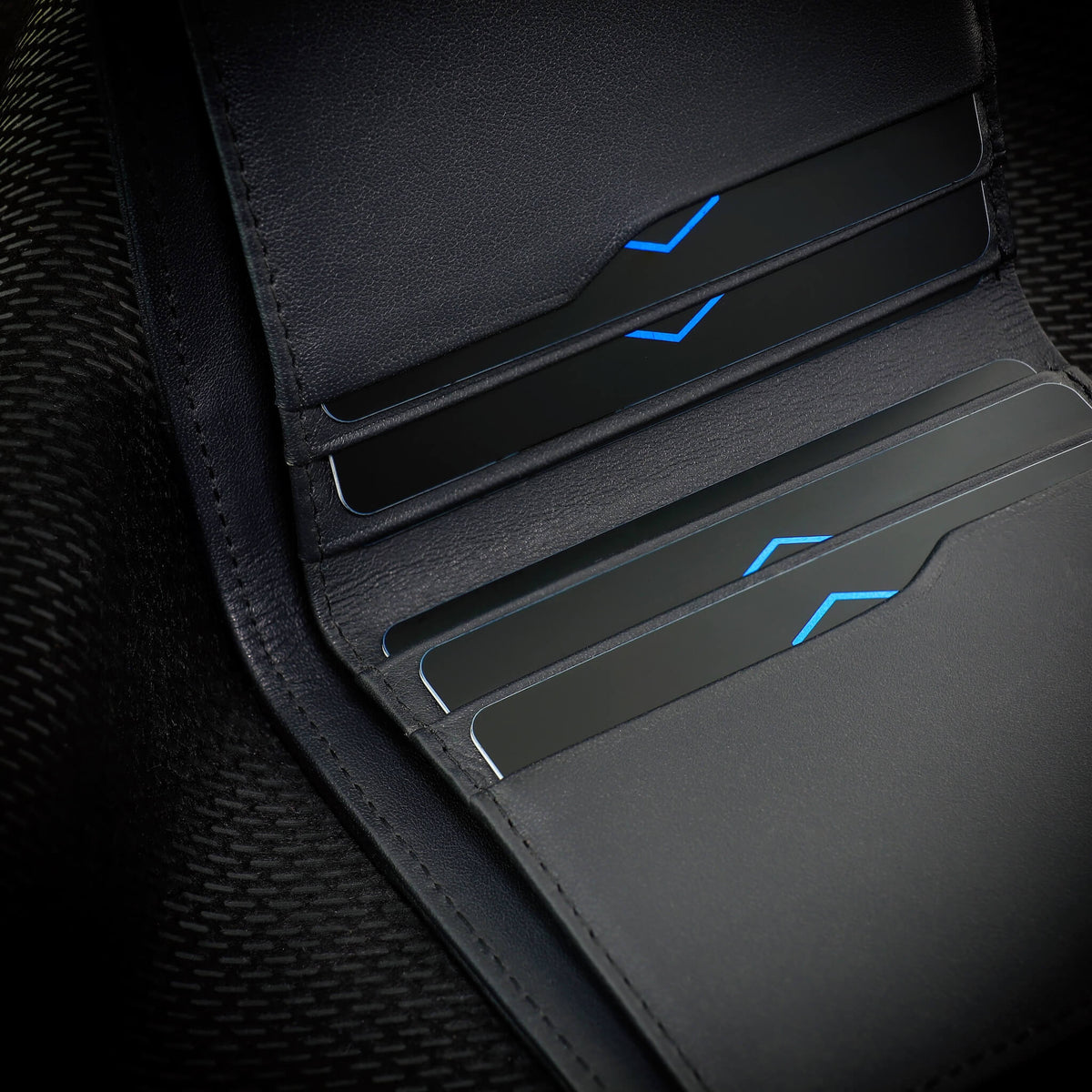
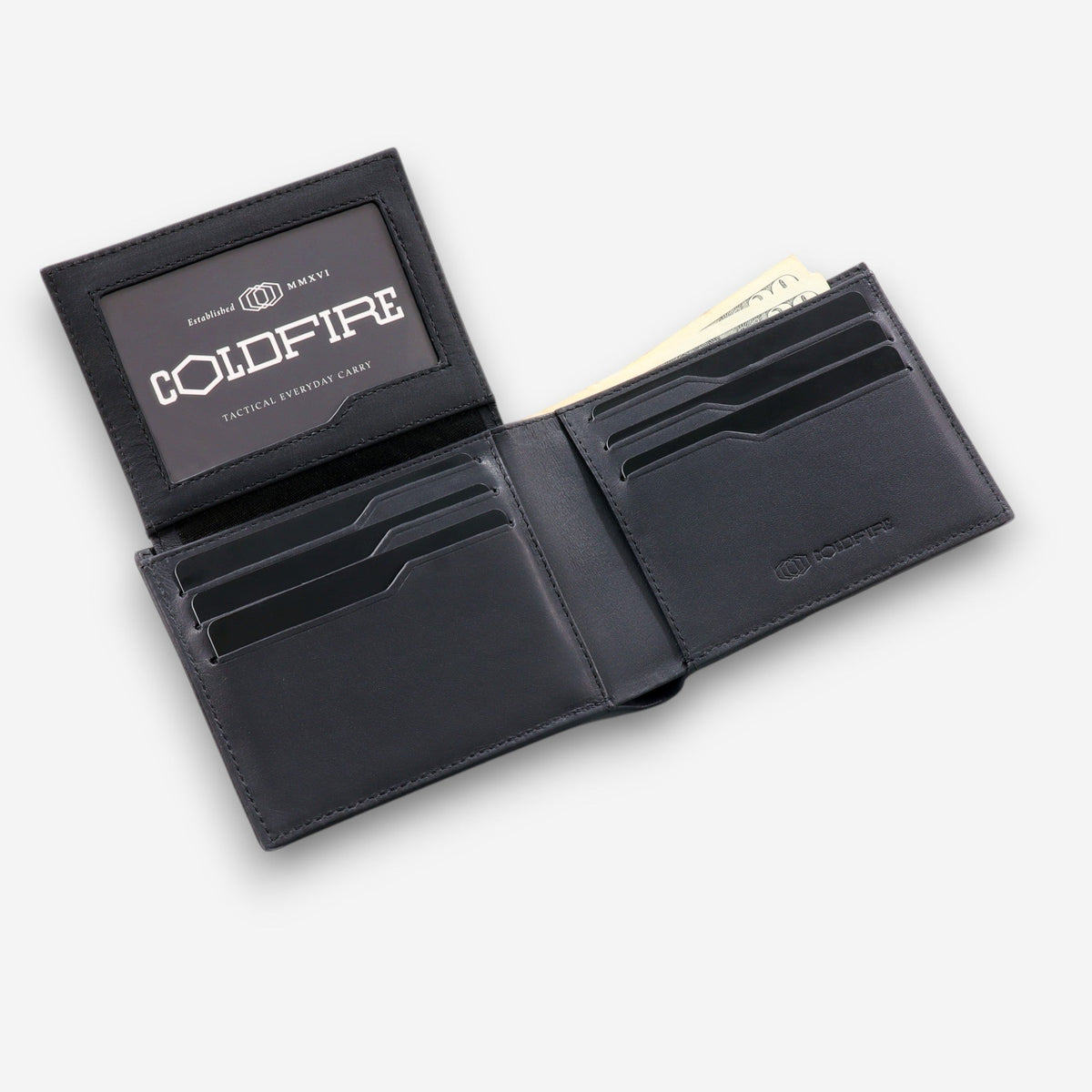
Best for: front-pocket carry where you want metal-grade shape retention without the metal block. This is ours. The shell is Carbitex Omniflex, a woven flexible carbon fiber roughly ten times stronger than steel by weight that flexes with the pocket and returns flat for the life of the wallet; it does not fatigue, corrode or stretch. The interior is kangaroo leather, which has parallel fibers and holds card slots tight where cowhide relaxes. There is no strap, clip or mechanism, so the only wear item is the stitching, which is bonded Amann Strongbond thread. Made by hand in Plovdiv, Bulgaria.
Pros: 46 g and 5.5 mm closed, 7–10 mm with four cards; nothing to replace; 5-year warranty; the thickness you buy is the thickness you keep. RFID Data Armor shielding rated at 13.56 MHz.
Cons: four cards and bills is the honest capacity; if you carry eight, you want the Strike Pro from the same family, not this. No patina, ever, which leather people will count against it. €199 is a premium over every leather bifold on this list except shell cordovan.
Specs and materials: Flex One · materials page.
3. Ashland Leather Johnny the Fox — the most durable leather
Best for: the person who wants leather and wants it to last decades. Hand-made in Chicago a few streets from the Horween tannery, in Horween Dublin or, if you pay for it, shell cordovan, which is the densest-fibered leather sold and the only one that does not stretch meaningfully. Lifetime guarantee on stitching and leather.
Pros: shell cordovan option, no mechanisms, lifetime guarantee, real craftsmanship.
Cons: Ashland publishes no weight or thickness; it is a traditional full-size bifold and carries like one. Frequently sold out. Shell cordovan editions start at $295.
4. NOMAD Bifold Wallet — Horween with thermoformed slots
Best for: maximum capacity in Horween leather. Fifteen card slots, thermoformed so they hold shape better than cut-and-stitched slots, unfolded bills, 57 g.
Pros: capacity, Horween veg-tan, shaped slots, honest weight figure.
Cons: 21 mm closed is the thickest wallet here, and it is thicker again when loaded. Reviewers note the grainy surface scratches within the first week. 2-year warranty is short for a $139 leather wallet, and there is no RFID option.
5. Popov Leather Traditional Bifold — thick hide, lifetime guarantee
Best for: a classic, heavy-leather bifold from a small maker (Nelson, British Columbia) with a lifetime guarantee that includes shipping. Seidel full-grain leather, 12.7 mm closed.
Pros: very thick hide, lifetime guarantee, six slots that stay tight for a long time precisely because they start tight.
Cons: slots are hard to use for the first weeks; weight not published; priced in CAD; since mid-2026 it cannot ship to a dozen EU countries.
6. Bull Sheath Leather Rio Grande — Texas-made Horween
Best for: someone who wants a made-to-order American bifold in Horween veg-tan with a guarantee that simply says they will fix or replace it. 60-day free returns in the US.
Pros: full-grain Horween, made in Texas, no mechanisms, responsive small maker.
Cons: reviewers call it bulky; no published weight, thickness or warranty term; RFID is a $10 add-on rather than built in.
7. Bellroy Note Sleeve — the durable mainstream choice
Best for: the person who wants one wallet from a brand with real service, and would rather have a 3-year warranty and a $90 price than chase the perfect material. Environmentally certified leather, flat bill section that takes tall currencies, coin pocket.
Pros: good leather for the money, 3-year warranty, sensible layout.
Cons: it is still cowhide; slots relax after a year and the wallet thickens. Bellroy publishes no weight or thickness. Too deep for a front pocket.
8. Secrid Slimwallet — durable case, consumable slider
Best for: someone who wants cards in a crush-proof aluminium case with a push ejector, wrapped in leather for bills. Dutch-made and widely serviced.
Pros: the case protects cards better than any leather; 12-card capacity; quick access.
Cons: the slider is a mechanism and business cards jam it; the leather wrap stretches like any cowhide; ~16 mm closed; a 2-year warranty on a $99 wallet.
The verdict by carry style
- Indestructible, comfort secondary: The Ridge, ideally titanium.
- Indestructible and comfortable, front pocket, four cards: COLDFIRE Flex One.
- Leather that will outlive you: Ashland Johnny the Fox in shell cordovan.
- Leather, big capacity: NOMAD Bifold.
- Leather, small maker, lifetime guarantee, under $150: Popov or Bull Sheath.
- Mainstream and sensible: Bellroy Note Sleeve.
Frequently asked questions
What is the most durable wallet material?
By stretch resistance and fatigue life: metal plates and woven carbon fiber composite, then shell cordovan and kangaroo leather, then full-grain cowhide, then everything sold as "genuine leather". Metal and rigid carbon win on impact; flexible carbon fiber wins on comfort at the same strength.
Why do leather wallets get thicker over time?
Because leather fibers shift every time a card goes in and do not shift back. Dense parallel-fiber hides (kangaroo, shell cordovan) resist this; loose-fiber cowhide and bonded leather do not. Composite and metal wallets do not change thickness at all.
Is a lifetime warranty a sign of durability?
It is a sign the maker expects few claims, which usually means the structure is sound. Read what it covers: Ridge covers loss and theft; most leather makers cover stitching and material defects under normal use, not wear.
Do carbon fiber wallets crack?
Rigid molded carbon plates can crack under a sharp point load, like being sat on against a hard edge. Woven flexible carbon fiber such as Carbitex Omniflex is engineered to bend repeatedly without fatigue and does not crack in normal carry.

Share:
Men's Leather Belts: How to Buy One That Lasts
Best RFID-Blocking Bifold Wallets for Business Travel (2026)