
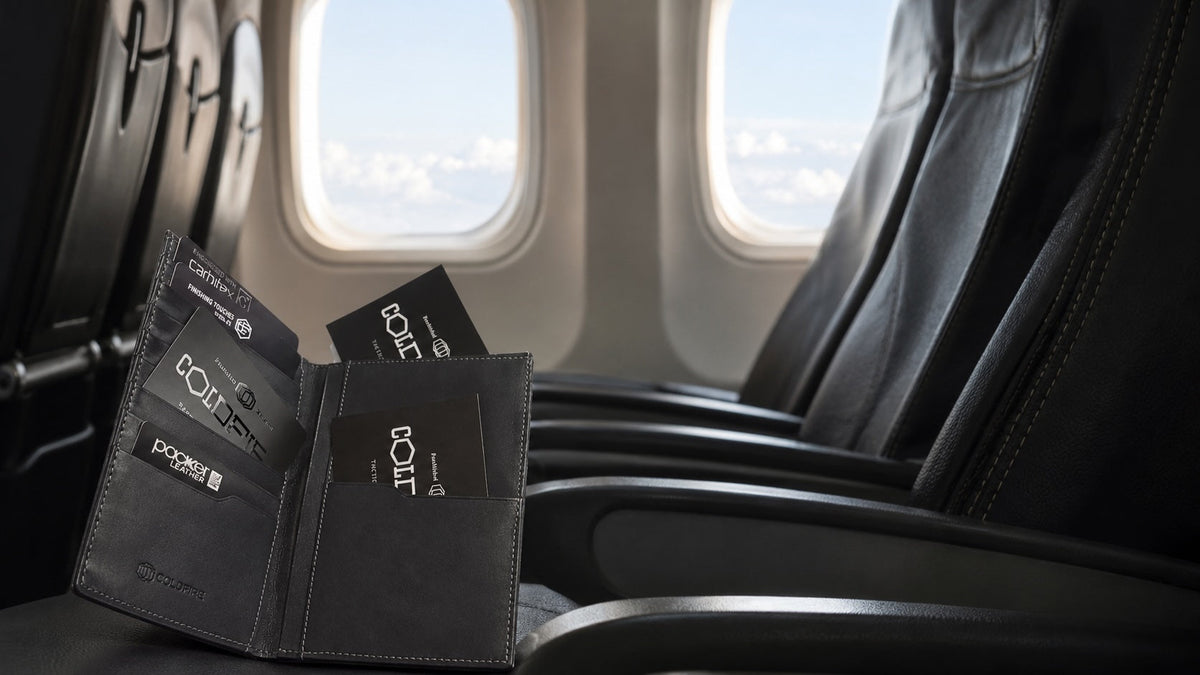
A passport holder and a travel wallet solve two different problems, and most people buy the wrong one because the shops use the names interchangeably. A passport holder protects one document and keeps it with the one or two cards you need at the counter. A travel wallet replaces your everyday wallet for the length of the trip and carries everything: passport, cards, two currencies, boarding pass, a hotel key. This guide explains the difference, what each one should be made of, whether a passport actually needs RFID blocking, and how to choose between them. We make both kinds in Plovdiv, so the last section is ours; everything before it applies to any brand.

The short answer
Buy a passport holder if you travel a few times a year and keep your normal wallet in your other pocket: it should be slim, hold the passport plus two or three cards and a folded note or two, and have shielding in the passport compartment. Buy a travel wallet if you cross borders often, carry more than one currency, or want a single object that holds every document for the trip: it needs real card slots, a full-length bill compartment, a pen loop or a boarding pass pocket, and materials that survive being handled fifty times a day. Either way, choose a material that does not stretch around the passport, because a loose sleeve is the first thing that fails.
Passport cover, passport holder, passport wallet, travel wallet: what the names mean
The words are used loosely, so here is how we use them, and roughly how the market does.
- Passport cover. A sleeve the passport slides into, with no pockets or one flat slip. It protects the booklet from corners and coffee and nothing else. Usually leather, sometimes silicone.
- Passport holder. A cover with one or two compartments alongside the passport for a card, an ID and folded cash. Slim enough for a jacket pocket. This is what most men mean when they search for one.
- Passport wallet. A larger folder with proper card slots and a bill section, sized so the passport is one item among several. For many people it is the travel wallet.
- Travel wallet or travel organiser. The full format: multiple card slots, a long bill compartment that takes unfolded euros and dollars, slip pockets for boarding passes and receipts, sometimes a pen loop or a SIM slot. It replaces your daily wallet for the trip.
Every one of them is built around the same object: a passport booklet of 125 by 88 mm, the ICAO ID-3 size used by almost every country. A holder that fits a US passport fits a German or a Japanese one.
What you actually carry through an airport
Lay out what you handle between the kerb and the gate: passport, boarding pass (paper or phone), one payment card, sometimes a residence card or a visa printout, and in the destination currency a little cash. That is the counter set, and a good passport holder keeps exactly this together so one motion produces all of it. Everything else, loyalty cards, the second currency, the hotel key, the spare card you keep separate in case the first is skimmed or lost, is the trip set. A travel wallet holds both sets; a passport holder holds the first and leaves the second to your normal wallet.
The practical test before buying is to count. If your counter set is passport plus two cards, a holder with two compartments is right and anything bigger is bulk. If you routinely hold boarding passes for a family, or carry cards for two countries, you have outgrown a holder.
Does a passport need RFID blocking?
Honestly: less than the marketing suggests, and the shielding is still worth having for a different reason. Biometric passports issued since the mid 2000s carry a contactless chip, and the chip can only be read after the reader has optically scanned the data page: the machine-readable zone acts as the key. This is called Basic Access Control, and it means a stranger with a reader in a crowd cannot open your passport chip the way they could in theory tap a contactless card. Several countries also build a shielding layer into the passport cover itself, so the chip cannot be read while the booklet is closed.
So why shield the compartment at all? Three reasons that have nothing to do with fear. First, the same compartment usually holds a payment card, and a contactless card has no access control: it answers any reader. Second, a shielded holder stops the passport chip and your cards answering accidental reads from the readers that are now everywhere, which is how you get a card charged at a turnstile you only walked past. Third, when you need the chip read, at an e-gate, you take the passport out and open it anyway, so the shielding costs you nothing. We set out what contactless skimming can and cannot do in Do You Need an RFID Wallet?; the short version is that shielding is a reasonable, low-cost feature, not a necessity, and a holder should be judged first on materials and layout.
Materials: what a travel wallet is put through
A passport holder has a harder life than a wallet. It is handled at every counter, pulled out of a jacket in rain, pressed into a seat-back pocket, carried in sweat on a hot day, and opened flat for scanners dozens of times a trip. Four things decide whether it looks like new after five years or like a boarding pass after one.
Stretch
The passport compartment is cut to fit the booklet. In soft cowhide or bonded leather it widens a little each time the passport goes in and out, until the booklet slides out upside down in a queue. The cure is a material that does not elongate: a composite shell, or a leather with the tensile strength to be cut thin and hold its width. This is the same failure that ends slim card wallets, explained in Why Leather Wallets Stretch.
Abrasion
A passport has square corners and a stiff cover, and it abrades the inside of the compartment every time it moves. Thin plain-weave fabric linings fray at the mouth within a year; a ripstop lining does not. Outside, the holder rubs against keys and phones in a jacket pocket, where full-grain leather scuffs and patinas and coated leather scuffs and peels.
Moisture
Rain, sweat and the occasional spilled drink. Full-grain leather tolerates damp and dries; bonded leather bubbles. Carbon fiber and synthetic linings are indifferent to it. Whatever the shell, the passport itself dislikes water more than the holder does, which is one argument for a closed sleeve over an open cover.
Weight and thickness
A holder you carry in a jacket's inside pocket should weigh under 100 grams with the passport, and a travel wallet should still close flat with two currencies in it. Rigid cases protect well but do not fit a jacket; soft folios fit but sag. The useful middle is a flexible shell that holds its shape without being a box.

Passport holder vs travel wallet, side by side
| Passport holder | Travel wallet | |
|---|---|---|
| Holds | Passport, 2 to 3 cards, folded cash | Passport, 6 to 10 cards, unfolded bills in two currencies, boarding passes |
| Replaces your wallet | No | Yes, for the trip |
| Typical size | About 100 by 145 mm, 5 to 8 mm thick | About 110 by 150 mm, 12 to 20 mm thick |
| Weight | 40 to 70 g | 80 to 150 g |
| Where it rides | Jacket inside pocket, shirt pocket | Jacket pocket, bag, or in hand at the counter |
| RFID shielding | Passport compartment, ideally the card compartment too | Card slots and passport compartment |
| Best for | Occasional travel, minimalists, a gift that will be used | Frequent flyers, multi-currency trips, family document carry |
| Price band | Roughly 40 to 150 euros for full-grain leather | Roughly 100 to 300 euros, more in exotic leather or luxury houses |
What makes a passport holder luxury, and what only looks it
The luxury houses sell passport covers at 300 to 600 euros, and some of them are beautifully made. What you are buying at that price is mostly the name, a full-grain calf or goatskin and an edge paint applied by hand. What you are not necessarily buying is stretch resistance, shielding or a lining that survives the passport's corners, because those are engineering features, and fashion houses sell finish, not engineering. The honest test of any luxury claim is the specification: the leather grade in words, the lining named, the hardware alloy stated. If a product page says "premium leather" and nothing else, you are paying for the box. Our seven questions every wallet brand should answer apply to passport holders unchanged.
The two we make
We build one of each, in different materials, for the two kinds of traveller described above. We make them, so weigh this section accordingly.
JetSet: the passport holder
The JetSet is the slim option, in form a passport cover with two side compartments: 100 by 145 by 5 mm, in full-grain Italian cowhide with a snake-print relief, a black top layer that wears to reveal a platinum-gold base, and a smooth calfskin nappa interior. There are no card slots, by design. Two side compartments take the passport on one side and two or three cards, an ID and folded notes on the other, which is the counter set and nothing more. The passport compartment is RFID shielded. It is edged and stitched by hand in Plovdiv, weighs around 50 to 60 grams, and costs 99 euros. If you want the Snake Eye leather story, it is in the collection notes.
Voyager: the travel wallet
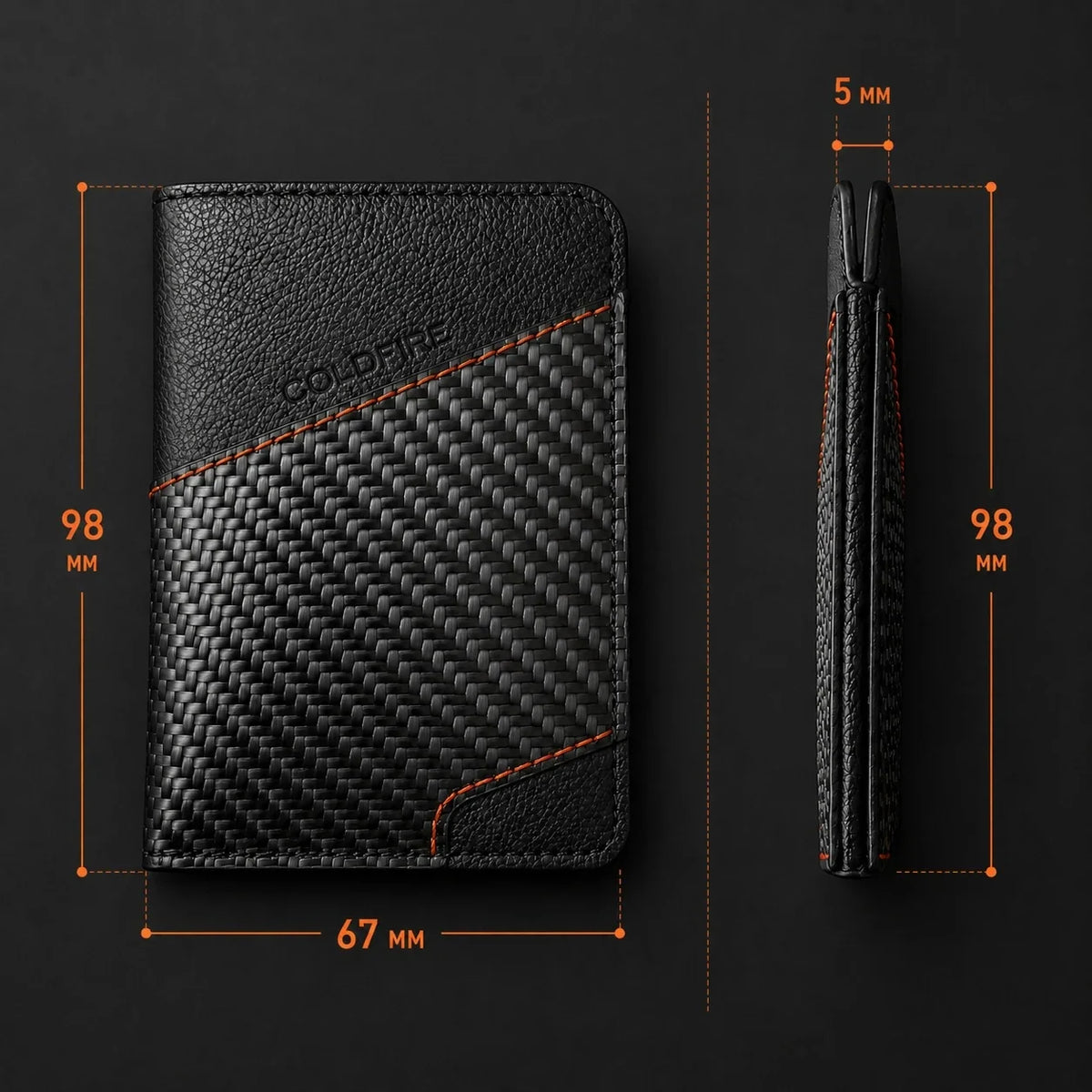
The Voyager is the full travel wallet, built from the same materials as our carbon fiber wallets: a Carbitex OmniFlex CX6 flexible carbon fiber shell, kangaroo leather interior, Dyneema ripstop lining, a Grade 5 titanium logo plate and RFID Data Armor shielding. 109 by 146 by 14 mm, 88 grams. Eight card slots, four slip pockets and a full bill compartment, so passport, cards from two countries, unfolded euros and dollars and a boarding pass sit in sequence and come out in order at the counter. The carbon shell is the answer to the stretch problem: the passport compartment stays the width it was cut at. 190 euros, five-year warranty, like everything we make.
- JetSet
- Passport holder. Full-grain Italian cowhide, snake-print. 100 x 145 x 5 mm, about 50 to 60 g. Passport + 2 to 3 cards + folded cash. RFID shielded passport compartment. 99 EUR.
- Voyager
- Travel wallet. Carbitex OmniFlex CX6 carbon fiber, kangaroo leather, Dyneema lining, Grade 5 titanium. 109 x 146 x 14 mm, 88 g. 8 card slots, 4 slip pockets, 1 bill compartment. RFID Data Armor. 190 EUR.
- Both
- Handcrafted in Plovdiv, Bulgaria. Five-year warranty. Shipped DDP worldwide, no import charges at delivery.
All travel pieces, including the two above, are in the Travel and EDC collection. Every material is named with its maker on the Engineering and Quality page.
How to choose
- Count your counter set. Passport plus two cards: a holder. More than four cards or two currencies: a travel wallet.
- Check the passport compartment material. It should not stretch. Thin soft leather with no backing will.
- Look at the lining. Named ripstop or a tight weave. Unnamed shiny fabric frays.
- Ask where the shielding is. The passport compartment at minimum, the card compartment ideally, and understand that it is a convenience, not a shield against a theoretical attack.
- Weigh it with the passport in. Under 100 g for a jacket pocket; under 200 g loaded for a travel wallet.
- Read the warranty. One that covers stretching and loss of shape means the maker expects the compartment to hold.
Passport holder questions, answered
What is the difference between a passport holder and a travel wallet?
A passport holder is a slim sleeve for the passport plus two or three cards and folded cash, carried alongside your normal wallet. A travel wallet replaces your wallet for the trip, with multiple card slots, a full-length bill compartment for two currencies and pockets for boarding passes. Choose by how many items you handle at the counter.
Does a passport need RFID blocking?
Not strictly. Biometric passport chips use Basic Access Control, which requires the data page to be optically read before the chip will respond, and many passport covers are already shielded. Shielding in a holder is still useful because the same compartment usually holds a contactless payment card, which has no such protection, and because it prevents accidental reads at the gates and terminals you walk past.
What size is a passport holder?
Passports follow the ICAO ID-3 format of 125 by 88 mm, so a holder's inside compartment is cut to that and the outside is typically 100 to 110 mm wide and 145 to 150 mm tall. A slim holder is 5 to 8 mm thick; a travel wallet 12 to 20 mm.
Is a leather passport holder worth it?
If you travel more than twice a year, yes: it keeps the passport flat and dry and puts it in the same place every time. Full-grain leather lasts a decade; bonded or "genuine" split leather peels within two years. The compartment material matters more than the brand.
Can I leave the passport in the holder at security and e-gates?
At a staffed counter, usually yes, the officer will take it out or ask you to. At an e-gate you remove it and open it to the data page, since the gate needs to scan the page before it can read the chip. A holder you can open one-handed saves time here.
What is the best passport holder for men?
For occasional travel, a slim full-grain leather holder with a shielded passport compartment and room for two or three cards, around 100 euros. For frequent travel, a travel wallet with a shell that does not stretch, a ripstop lining, eight or more card slots and a full bill compartment. Judge any candidate by named materials and the warranty wording, not by the logo.
Written by Todor Georgiev, founder of COLDFIRE and a leather goods manufacturer in Plovdiv since 2000. Published 3 November 2026. Passport dimensions per ICAO Doc 9303; chip access control per the same standard. Sizes, weights and prices for JetSet and Voyager are current COLDFIRE specifications.

Share:
What Is the Strongest Wallet Material? Carbon Fiber, Titanium, Kangaroo Leather and Dyneema Compared
Minimalist Wallets Explained: The 5 Formats, How Many Cards, and the Best of 2026